
How is AI Talking About Your Nonprofit?

Is AI Talking About Your Nonprofit?
10 Ways to Improve Your Visibility
AI is quickly changing how people find organizations online.
Someone looking for support, a place to volunteer, or an organization to donate to might still start with Google. But increasingly, they may also ask ChatGPT, Gemini, Copilot, Perplexity, or another AI-powered search tool.
That creates new challenges for organizations who are in need of both donations and volunteers.
When someone asks AI about organizations like yours, does your organization show up?
At The Bridge 2026 in London, Ontario, an annual event focused on non-profit organizations, Jenna Lamb from Foundery spoke about practical ways nonprofits can improve their visibility in AI-powered search. The good news is that you do not need a large marketing budget or an entirely new “AI strategy” to get started with this.
Many of the things that help AI understand and trust your organization are the same things that have always supported strong SEO: clear information, consistent brand signals, useful content, and a technically accessible website.
Here are 10 things you can do to improve your organization’s visibility across the evolving search landscape.
Search Is Changing
There are two important shifts happening at the same time.
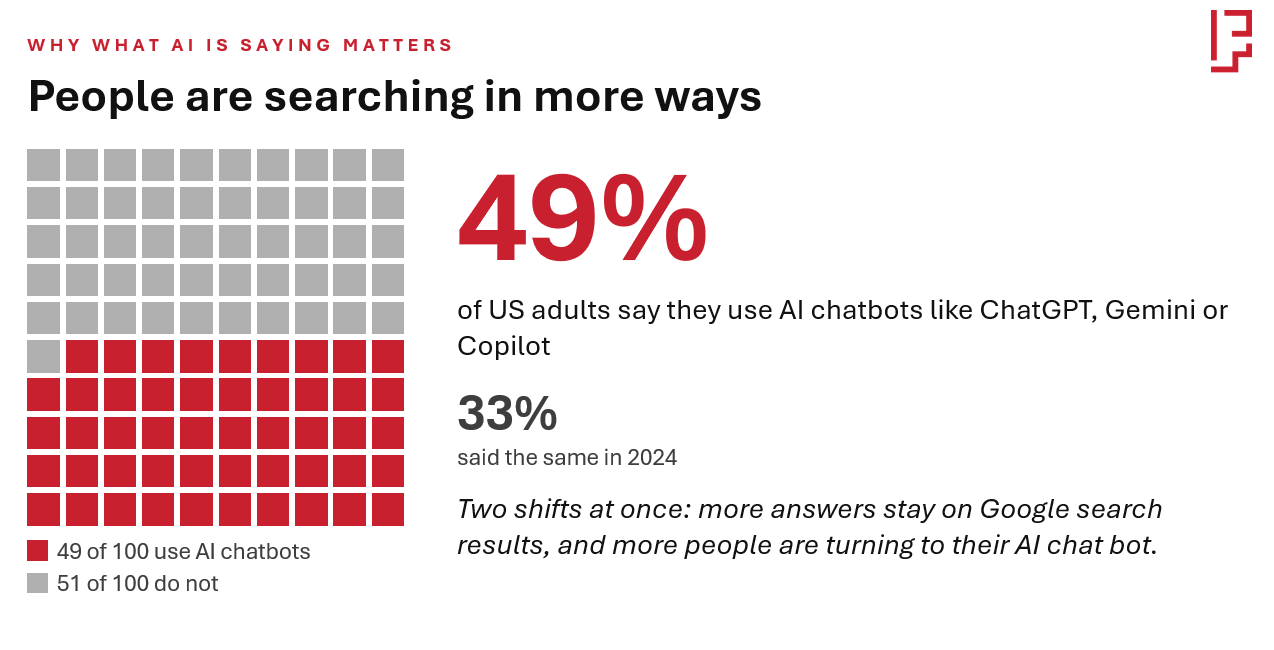
First, more searches are being answered directly within Google. People can get information from featured results, AI Overviews, maps, and other search features without necessarily clicking through to a website.
Second, people are increasingly using AI tools to research organizations, services, products, and recommendations.
That means visibility is no longer only about ranking well in traditional search results. Your organization also needs to be understandable and credible enough to be referenced when AI systems generate an answer.
Those systems are looking beyond your website. They may encounter your organization through Google Business Profile, directories, social profiles, news coverage, partner websites, and other sources. That makes consistency more important than ever.
Image
Being Mentioned Is Not the Same as Being Recommended
Try a simple experiment. Ask ChatGPT, Gemini or Copilot:
“Which organizations in London, Ontario help with [your cause]?”
Look at which organizations appear. Then ask:
“Which organization would you recommend for someone who needs [specific service]?”
Those are two different questions. The first tests whether an AI tool knows your organization exists. The second asks it to evaluate whether your organization is relevant to a particular need.
There is no guaranteed formula for appearing in either answer. AI-generated responses can vary by tool, question and context. They are also highly personalized to the user. But you can make it easier for these systems to find accurate, useful information about you. That starts with the basics.
You Probably Don’t Need a Separate AI Strategy
There is a lot of new terminology around AI search: GEO, AEO, AISEO and more. For most organizations, focusing on marketing fundamentals is more important than chasing the latest tactics.
Strong SEO fundamentals remain the foundation for visibility in AI-powered search. Helpful content, expertise, authority, and you website’s technical performance and crawlability matter most.
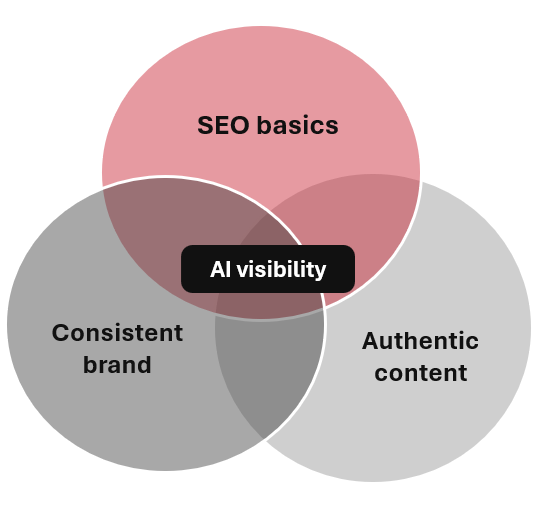
Think about AI visibility in three areas:
- Discoverability: Can search engines and AI systems find and understand your information?
- Consistency: Does your organization appear the same way everywhere online?
-
Authenticity: Are there real people, stories, facts and sources that demonstrate who you are and what you do?
Image

10 Simple Ways to Improve Your AI Visibility
1. Answer the Most Important Questions First
Visit your homepage, About page and main program or service pages.
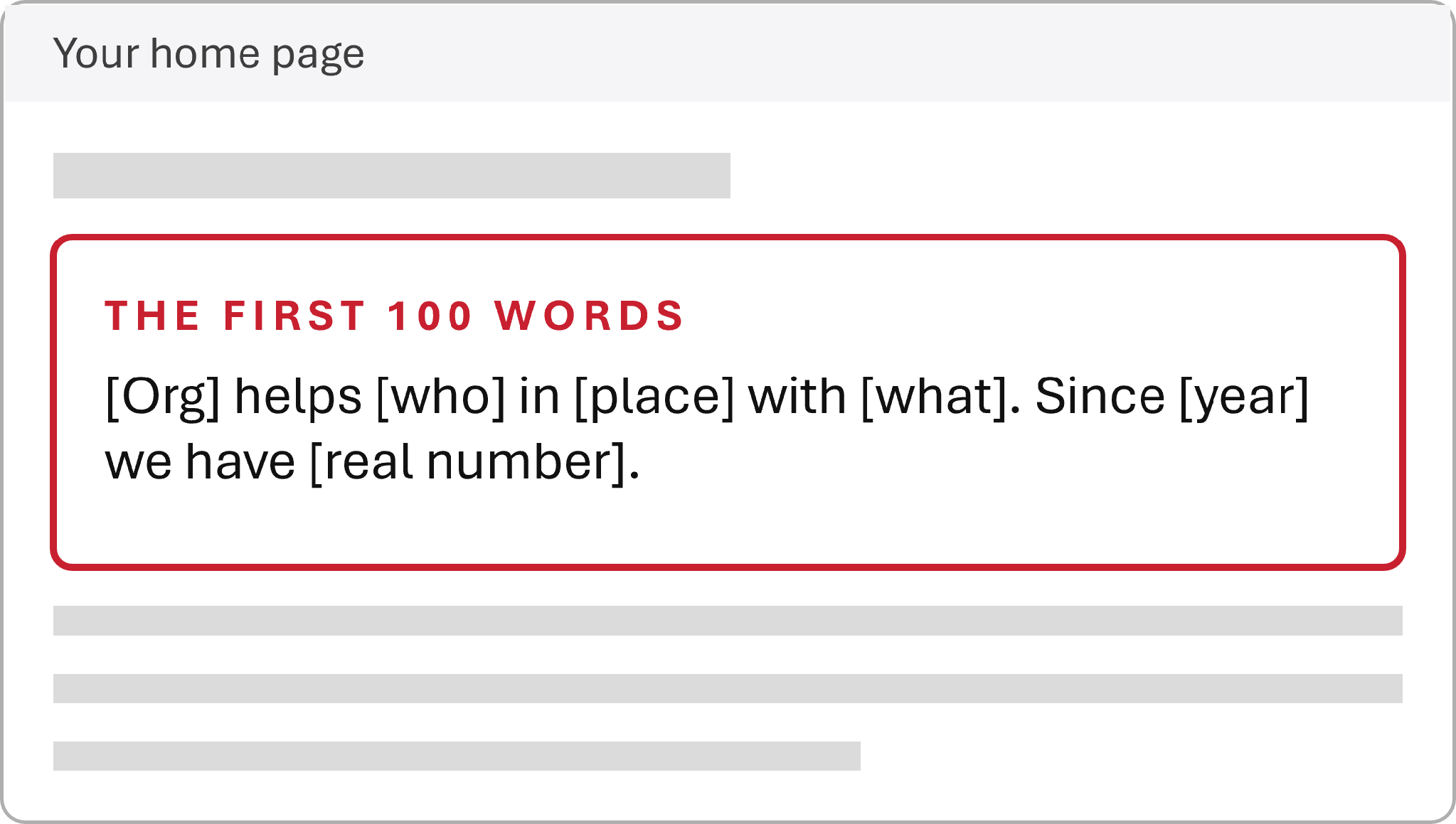
Within the first 100 words, can someone quickly understand:
- Who are you?
- What do you do?
- Who do you help?
- Where do you operate?
If not, simplify the opening.
You can also add a meaningful fact that demonstrates your organization’s experience, such as how long you have operated, how many people you supported last year, or how many volunteers are involved.
Do not make people, or search engines, hunt for answers or hide what you do in a mission statement buried in your footer.
Image
2. Answer the Questions People Actually Ask You
Your next content ideas are probably already sitting in your inbox.
Think about the questions your team regularly receives:
- How do I volunteer?
- Can I donate by cheque?
- Who qualifies for this program?
- Do you offer services outside London?
- How do I access help?
Turn those questions into clear website content.
A simple FAQ page is a good starting point, but important questions should also be answered on the relevant program or service pages.
One easy exercise: search your general inbox for phrases such as “how do I,” “can I,” “where can I” and “do you offer.” You may have months of useful content ideas already there.
3. Keep Important Information as Text on Your Website
Posters and graphics can look great, but they should not be the only place important information appears.
Your hours, address, contact information, services, eligibility requirements, donation information and volunteer opportunities should all be available as regular text on your website.
The same goes for important information buried only inside PDFs.
A good rule is simple: if someone needs to know it, put it on the webpage.
It improves accessibility for visitors and makes the information easier for search systems to understand.
4. Make Sure You’re Not Accidentally Blocking Crawlers
You can publish great content and still make it difficult for search engines or AI systems to access it.
Ask the person who manages your website to check whether crawlers are being blocked through robots.txt, Cloudflare, server or firewall settings, or other security tools.
You can start by visiting: yoursite.ca/robots.txt
You do not need to understand every line yourself. You can even ask your preferred AI tool to review this for you.
You should also ask your web provider:
“Are we blocking AI or search crawlers through Cloudflare, our server settings or robots.txt? If so, was that intentional?”
There can be legitimate reasons to restrict certain crawlers. The important thing is knowing whether you are doing it deliberately.
Image

5. Use One Name and One Set of Facts Everywhere
AI systems can encounter information about your nonprofit in many different places. Make those signals as consistent as possible.
Create a simple organization fact sheet containing:
- Your official organization name
- One-sentence description or mission
- Address and phone number
- Website
- Founding year
- Charity registration number, where applicable
Then check the places where your nonprofit appears online. For an Ontario nonprofit, that could include CanadaHelps, CRA charity records, 211 Ontario, Pillar Nonprofit Network, Information London and relevant community directories.
The goal is not to create dozens of listings. It is to make sure the reputable listings that already exist describe the same organization.
Your website should also clearly connect the organization to real people. Include appropriate staff and board information, your charity registration details and current annual reports where possible.
6. Claim and Update Your Google Business Profile
Your Google Business Profile is another important source of information about your organization.
Make sure the profile is claimed and that the details match your website, including your organization name, address, phone number, hours, website, services and description. Add current photos as well.
If your website says one thing and your Google profile says another, fix the discrepancy.
Consistency makes life easier for potential donors, volunteers and clients, not just search engines.
7. Publish Things Only Your Organization Can Say
This is where nonprofits have a major advantage. You have real stories.
You know how many people you helped. You know what happened at last month’s event. Your staff know the challenges facing the community. Your volunteers can explain why they got involved. Use that.
Instead of publishing another generic article such as “Five Ways to Be a Better Volunteer,” publish something specific to your organization.
For example: “How 47 volunteers helped us deliver 1,200 meals in London this winter.”
Include real numbers, dates, quotes and sources where appropriate, with permission from the people involved.
Specificity makes content more useful to people and provides clear evidence of the work your organization actually does to AI systems.
8. Make It Easy for Other Organizations to Describe You
Your own website should not be the only place explaining what you do.
Look at organizations already connected to your nonprofit:
- Funders
- Community partners
- Local media
- Chambers of commerce
- Colleges and universities
- Community foundations
- Municipal organizations
Choose five strong relationships and see how your organization is described on their websites.
If the description is outdated or incomplete, send them a short approved description, your correct organization name and a link to your website.
This is not about collecting random backlinks. It is about making sure reputable organizations in your community are accurately connecting your name with the work you actually do.
9. Ask for Stories, Not Just Stars
A five-star review looks good. A review explaining why someone valued your organization is much more useful.
When appropriate, encourage supporters, volunteers or community partners to describe their experience in their own words.
For example: “I started volunteering with the organization in 2024 and helped with three community food drives. The team made it easy to get involved and understand where help was needed.”
That says much more than “Great organization!”
For nonprofits providing confidential or sensitive services, public reviews may not be appropriate. In those cases, anonymous testimonials or approved stories published on your own website may make more sense.
10. Check What AI Says About You
Finally, keep an eye on what is actually happening. The AI search landscape is constantly changing. Once a month, try a few searches in your preferred LLM tools. We recommend ChatGPT, Google and Copilot for most organizations.
Start with: “What do you know about [organization], based in [city]? Where did you get this information?”
Then: “Which organizations in [city] help with [cause or service]?”
Do not worry about getting exactly the same answer every month. AI responses vary. Instead, look for patterns.
Is your organization appearing? Is the information accurate? Are important facts missing? Which sources are being referenced? Are competitors or similar organizations consistently appearing when you are not?
Keep a simple tracking sheet with: Date | Tool | Question | What appeared | Sources | What needs fixing
Over time, that gives you something much more useful than a single AI answer: a picture of how your organization is being represented across AI-powered discovery.
If You Only Have an Hour
You do not have to tackle all 10 things at once. If I had only an hour, I would start with three:
1. Rewrite the opening of your most important webpage. Make it immediately clear who you are, what you do, who you help and where.
2. Check your organization’s information across the web. Make sure your name, description, address and other important facts are consistent.
3. Ask AI what it knows about you. You cannot improve what you have not checked.
The third one takes about five minutes and is probably the easiest place to start. Ask ChatGPT, Google or Copilot what it knows about your organization and where the information came from. You may be surprised by what you find.
Get the Free Checklist
We have turned all 10 actions into a free checklist you can print, share with your team or work through one at a time. Download the AI checklist for nonprofits (PDF)
Want to Know How Your Organization Shows Up in AI?
If you are curious but do not have time to investigate it yourself, we can help connect you to our partners at Foundery.
An AI brand audit looks at how your organization currently appears in AI-powered search and where there may be opportunities to strengthen your visibility. Request your free AI brand audit from Foundery!
Date Nov 17, 2026
Author: Jenna Lamb