
Don’t Forget to Be Human: Authenticity in an AI World

Recently, I had the opportunity to give a presentation called “Don’t Forget to Be Human: Authenticity in an AI World” at The Bridge event. While the presentation was geared toward nonprofits, the idea behind it applies to pretty much any organization creating content today.
AI has completely changed how quickly we can create and do things. We can use it to write a first draft, summarize a report, brainstorm ideas, create a webpage or turn one piece of content into five different things. And honestly, that’s great - I think organizations should be using it where it helps improve efficiencies. There are a lot of ways it can make our jobs easier and help us do more with the time and resources we have.
However, there is also a downside. As AI makes it easier to create more content, we’re starting to see content that looks and sounds exactly the same.
The internet is filling up with “AI slop”
Image
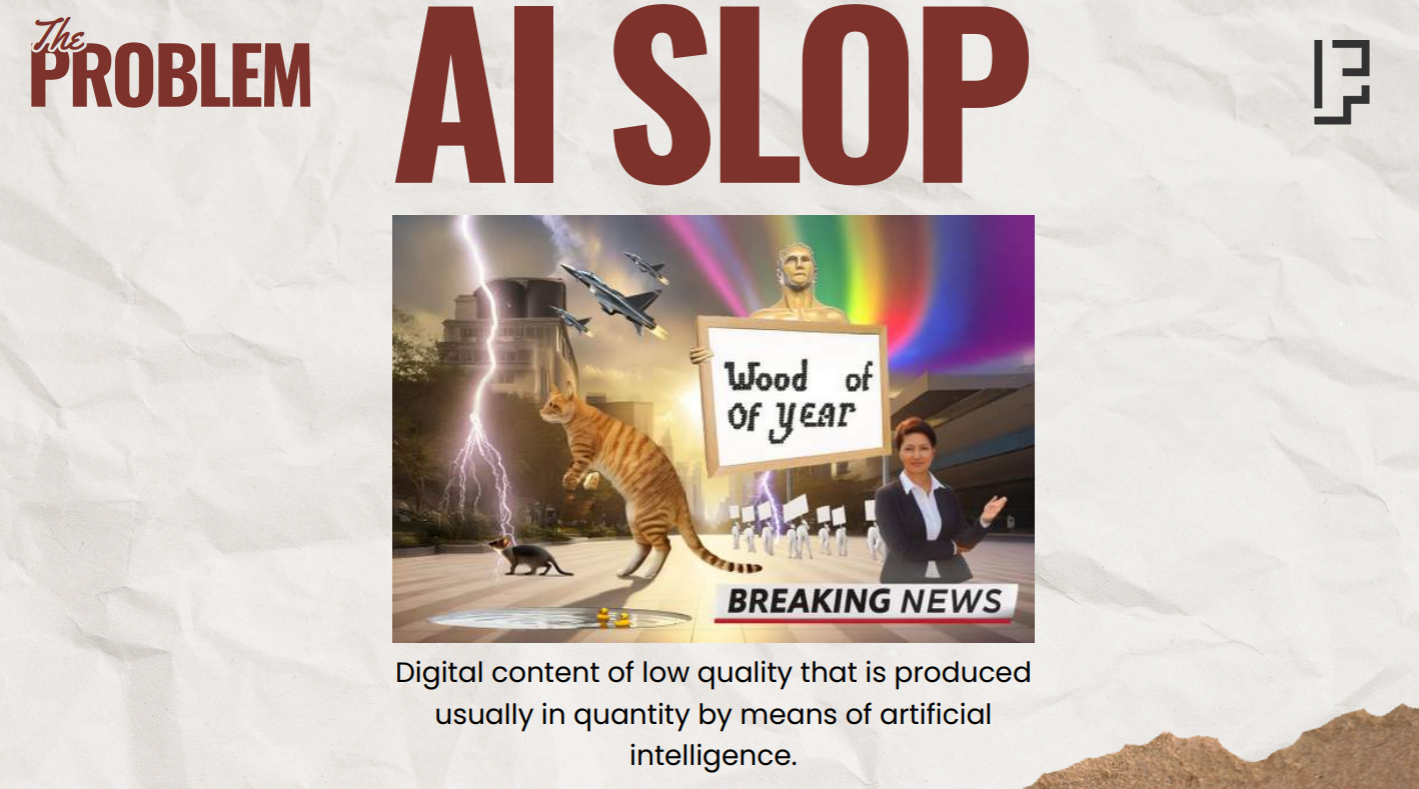
There’s a term being used more and more for low-value, mass-produced AI content: AI slop. If you’re on social media, you’ve definitely seen it.
It’s content that sounds polished but doesn’t really say anything. Social posts filled with generic corporate language. Blog articles that answer a question but don’t add anything new. Website copy about being “committed to excellence” or “making a meaningful difference” without actually explaining what that means.
It’s technically fine. But it’s also completely forgettable. And I think this creates an interesting opportunity, especially for nonprofits. As generic content becomes easier to create, real experience becomes more valuable.
AI doesn’t have your experience
One of the biggest points I wanted to make in the presentation was that AI can create content, but it cannot create your organization’s experience. It wasn’t there for the conversation with a family using your services. It doesn’t know why a volunteer has continued showing up for the past ten years. It hasn’t talked to your frontline staff about the questions they hear every day. It doesn’t know your community, your history or everything your organization has learned along the way.
Those are the things that make your content interesting.
AI can absolutely help you turn those experiences into content. It can organize interview notes, clean up a draft, suggest a better headline or turn a longer story into something you can use in an email or on social media. But someone still has to give it something worth talking about.
AI can help shape the story, but your people have to supply the substance.
Authentic doesn’t have to mean unpolished.
I also think it’s important to clarify what we mean when we talk about “authentic” content.
It doesn’t mean everything needs to be casual or written off the cuff. You can still have a professional brand and tone of voice. You can edit your content. You can use AI to make something easier to read.
Authenticity is really about being specific, honest and grounded in actual experience.
Here’s an example I used in the presentation.
Instead of:
“Our organization is committed to making a meaningful difference in the community through innovative programs and dedicated support.”
You could say:
“Last year, 74 local families used our emergency food delivery service. One of the biggest lessons we learned was that transportation, not food availability, was often the barrier.”
The first one might sound good, but the second one actually tells the reader something important. It gives a real number, a real problem and something the organization learned through experience.
That is much harder for another organization to copy, and it gives your audience a much better understanding of the work you actually do.
This matters for SEO and AI search too
Search engines, and increasingly AI-powered search experiences (Chat GPT, Claude, Gemini, etc.), are trying to find useful and trustworthy information that answers people’s questions.
Publishing more content isn't necessarily going to help with that. Publishing better, more original content can.
Think about all of the information sitting with your team that probably doesn't exist anywhere else online:
- Questions your staff hear every day
- Program data and outcomes
- Lessons learned from running your programs
- Local knowledge
- Volunteer experiences
- Community feedback
- Original surveys and research
- Expert perspectives
- Stories from the people doing the work
Including these details can make your content more useful for your audience while also giving search engines and AI tools more unique information to understand and potentially reference.
Don’t try to publish the most content. Publish content that only your organization could credibly create.
Start with the human source
One of the easiest ways to do this is to change where your content starts. Instead of opening an AI tool and typing:
Write me a 1,000-word blog about…
Start with something real:
- Interview a staff member.
- Talk to a volunteer.
- Look through questions that have come through your website forms.
- Review emails people regularly send your organization.
- Look at your annual report, workshop recordings, surveys or program notes.
Then use AI.
Ask it to help organize the information. Turn an interview transcript into a draft. Find themes in the questions people are asking. Simplify complicated language. Suggest headings. Turn a longer story into a newsletter or social post.
You still get the efficiency of AI, but the starting point is your organization's knowledge rather than the AI's knowledge. That's a pretty important difference.
2. Use the S.E.E.N. formula
A simple framework organizations can use to evaluate their content is called the S.E.E.N. formula.
Image
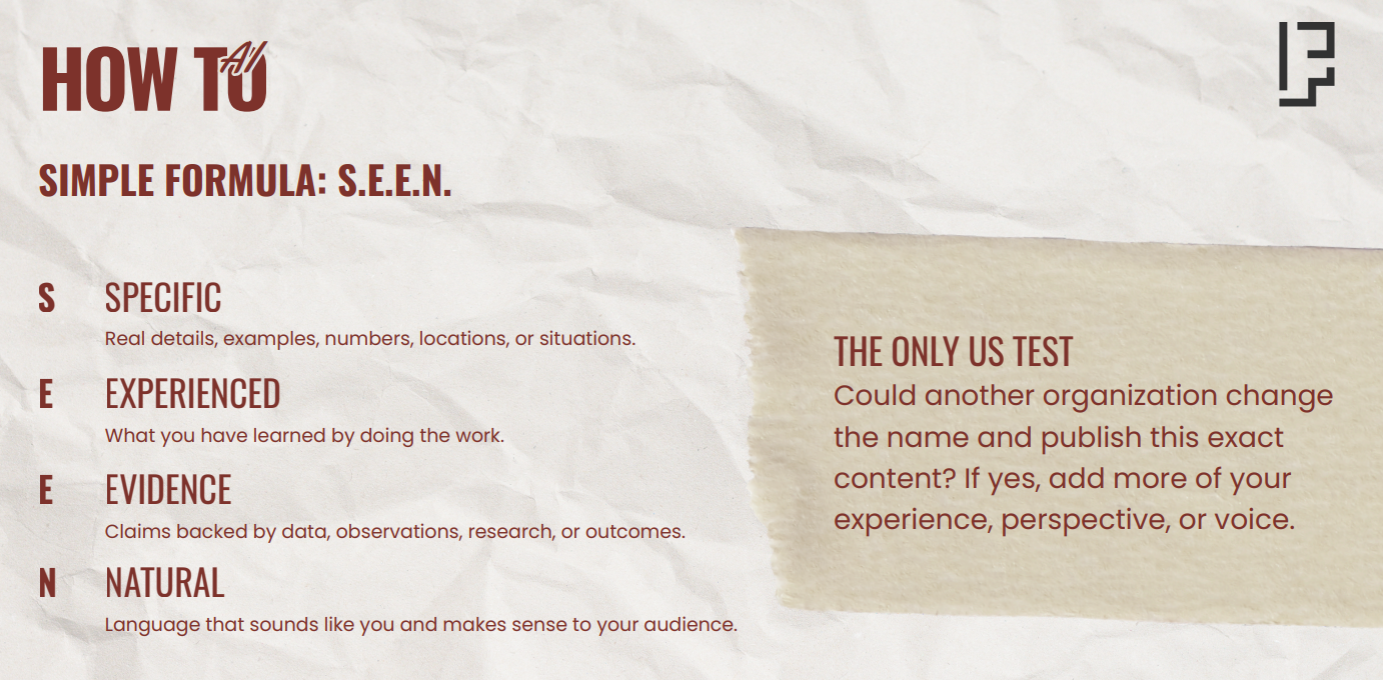
Specific
Include actual details, examples, numbers, locations and situations.
Experienced
Show what you've learned by actually doing the work.
Evidenced
Back up your claims with data, observations, research or outcomes where possible.
Natural
Write in language your audience understands and that actually sounds like your organization.
There’s also a very simple question you can ask before publishing something:
3. Could another organization change the name and logo and publish this exact content?
If the answer is yes, there’s probably an opportunity to make your content more specific.
- Add an example.
- Add something your staff have learned.
- Include an original statistic.
- Answer a question you regularly receive.
- Give your perspective.
Essentially, share details they couldn’t get from anyone else.
4. Utilize the Human Check for your content
I also shared five questions organizations can use when reviewing AI-assisted content:
Is it true?
Are the claims, numbers, quotes and examples accurate?
Is it ours?
Does this include something from our actual experience, knowledge or perspective?
Is it useful?
Does it genuinely help someone understand something, answer a question or make a decision?
Does it sound like us?
Would someone familiar with our organization recognize our voice?
Is a human accountable?
Has someone who understands the subject actually reviewed it?
It doesn’t need to be a complicated process. Even adding these five questions to an existing content approval process can catch a lot.
Let AI help you tell your story
My takeaway from preparing and giving this presentation wasn't that nonprofits should use less AI. It's that we need to be more thoughtful about where AI fits into the process.
There’s a lot that AI can help us do faster. But speed isn't really the thing that makes an organization worth paying attention to.
Your advantage is your people.
It's your experience.
It's your relationships.
It's what you've learned from actually doing the work.
It's the knowledge you have about your community and the people you serve.
Using AI doesn't make your content inauthentic. Removing the human experience from the process does.
So, if you're not sure where to start, keep it simple.
This week:
- Review one important page on your website.
- Talk to one person who is close to the work.
- Improve one piece of content by adding a real example, insight or outcome.
AI can make content faster.
Humanity makes it worth reading.
And ultimately, that's the point I wanted people to walk away with:
Let AI help you tell your story. Don't let it become the story.
Date: November 20, 2026
Author: Joshua Waller
foundery.ca